
What actually happens in the first session?
Play. Genuinely, mostly, play.
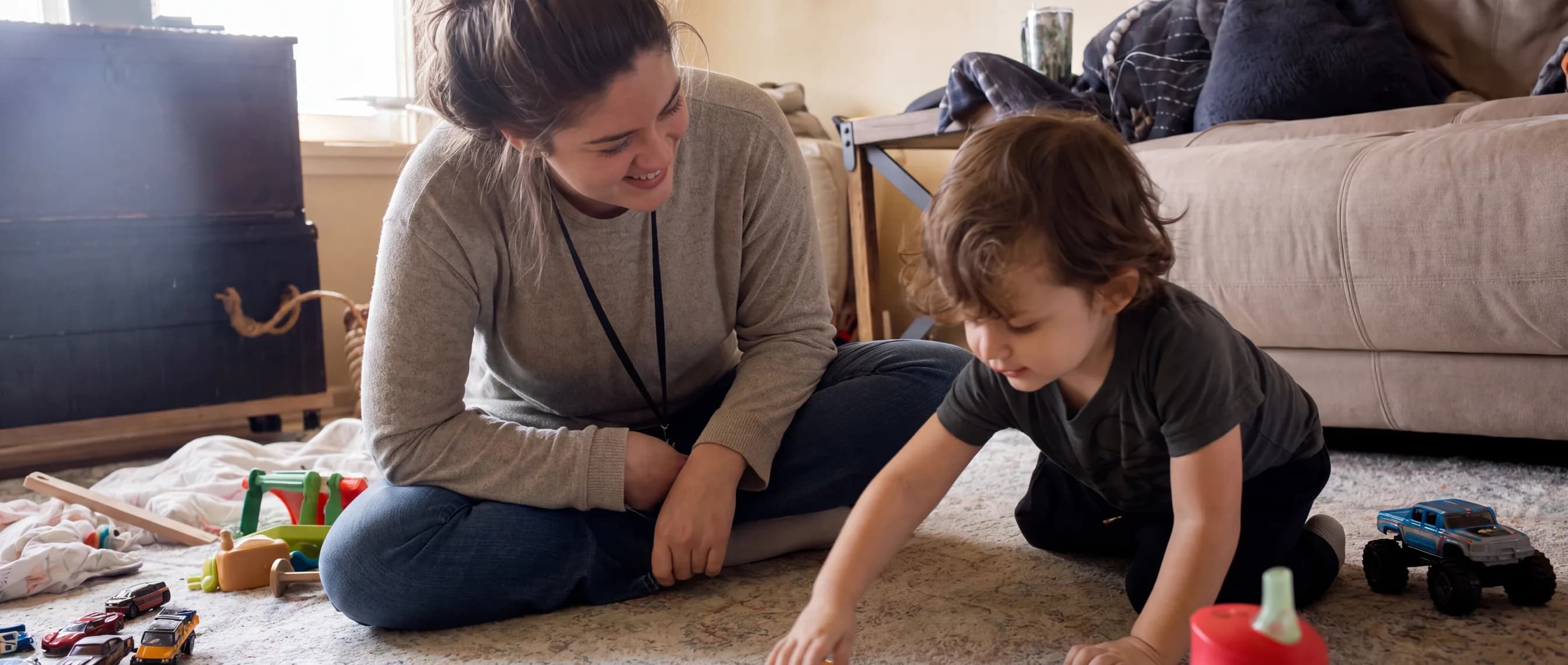
Your child's behavior technician arrives — at your home, or in a room at our Golden Valley center — and follows your child's lead. If your child wants to line up cars for forty minutes, the session is about cars. Nothing is demanded. Nothing has to be earned. There is no table, no flashcards, and no list your child is being tested against.
If your child ignores the technician completely, the technician stays nearby anyway, being pleasant and asking for nothing.
That is not a soft start or a wasted hour. It's the first real piece of clinical work, and it has a name.
Why does it look like play?
Because of a stage called pairing — and it's the thing most worth understanding before therapy starts.
Before a technician asks anything of your child, they have to become someone your child is glad to see. Not tolerated. Glad. That's built the only way it can be: by being present while good things happen and asking for nothing in return.
The reason this is worth a week of your child's life is the alternative. A child who learns that this particular adult means demands will start avoiding that adult — and avoidance is far harder to undo than to prevent. Every hour of teaching after that gets more expensive. Pairing isn't the delay before the work; it's the thing that makes the work possible.
So if session one looks like a stranger playing with your kid on your living room floor, the plan is running correctly.
Who's who in the room?
Two roles, and they're easy to mix up.
The behavior technician — often an RBT, a Registered Behavior Technician — is who your child sees. They deliver the sessions, they run the plan as written, and they take data as they go. They're the relationship. Most of your child's therapy hours are with this person.
The BCBA — a Board Certified Behavior Analyst — is who designs it. They write your child's treatment plan, decide which goals come next, read the data, and change what isn't working. They're the clinical judgment behind every session, and they supervise the technicians running it.
The part worth asking any provider about: how often the BCBA actually shows up. At our center, a supervising BCBA provides routine, near-daily supervision of the technicians delivering each child's plan — checking that it's being run as written, which is what keeps a treatment plan from drifting into whatever the room felt like that day. The field's minimum is monthly. It's a fair question to ask us and everyone else you're considering; we wrote a whole post on questions like it.
What do you do?
Less than you fear in the session, more than you expect around it.
If your child's therapy is in your home, an adult needs to be in the house, and how involved you are in the session itself is something you work out with your team — your presence helps for some goals and gets in the way of others, and your BCBA will tell you which is which. Over time you're coached inside your own routines, because the routines are the point: the front door, the bath, the sibling who won't share.
If your child's therapy is at the center, you don't stay for the session. Your involvement is real but scheduled — caregiver training arranged around what works for your family, plus progress reviews.
Either way, parent training is a covered EIDBI service in its own right, not a favor or an add-on. And the single most useful thing you can do in the first weeks costs nothing: tell the team what you know. What your child loves, what set them off yesterday, what the word that isn't quite a word means. You have data no assessment will surface, and the plan gets better when it has it.
What do the first two weeks look like?
Roughly this — with the loudest possible caveat that your child's version will differ, and differing is not a problem.
Session one
Play, and not much else. Your child's technician follows their lead — whatever your child is already interested in is what the session is about. No demands, no table, nothing your child has to earn. If your child spends the hour ignoring the technician entirely, the technician stays anyway, being pleasant and undemanding nearby. That is the session working, not failing.
What’s normal here: Anything from delighted to furious. Some children are in someone's lap by minute ten; some cry the whole time; some watch from across the room and touch nothing. None of those predicts how therapy goes.
The first week
More of the same, deliberately. Pairing continues until your child reliably treats the technician as a good thing to have around, and the honest answer on how long that takes is that it depends on the child. Alongside it, the team is quietly learning your child — what they love, what they avoid, what a good day looks like — which is the raw material the treatment plan runs on.
What’s normal here: A week of play with no visible teaching is a normal week one. So is a child who seemed fine on day one and falls apart on day three; new people are work, and the tiredness shows up late.
Around week two
Goals start appearing inside the play, usually before you notice them. A request your child was going to make anyway gets shaped into a clearer one. A game gains one small step. The session still looks like play because it mostly is play — that's Natural Environment Teaching doing its job, not a slow start.
What’s normal here: Some children are working goals by day three; some are still pairing at week three, and a technician who tells you they're still pairing is telling you the truth rather than making an excuse. Progress that starts later isn't progress that ends smaller.
The first months
The rhythm settles: your child's plan runs session to session, data gets taken as they go, and the BCBA adjusts what isn't working. You'll start hearing specifics instead of impressions — which prompt is fading, which skill moved. Your own training sessions get scheduled around what works for your family.
What’s normal here: Regression during holidays, illness, or a house move is expected and planned for. So are plateaus. A skill that goes backwards for two weeks is a normal shape for learning, not a sign the plan is wrong.
Read that as a shape, not a schedule. The one thing that reliably makes it worse is measuring your child against another child's pace.
What's normal to worry about?
Some things that alarm parents in the first month and shouldn't:
- Crying, at first. A new person or a new room is genuinely a lot at two or three. What matters is that the team responds by backing off and staying pleasant, not by pushing through.
- Nothing visible happening. Weeks of play with no obvious teaching is pairing working. Ask what stage you're in — you'll get a straight answer.
- It gets worse before it gets better. Behaviors sometimes escalate briefly when something that used to work stops working. Your BCBA should have told you this was coming; if it's happening and no one has explained it, ask today.
- Regression around holidays, illness, or a move. Expected, planned for, and not a verdict on the plan.
And two things that are actually worth escalating: you can't get a straight answer about what's being worked on, or you're watching your child struggle and nobody is explaining why. Neither is normal, from us or anyone. Raise it the same day, with the BCBA rather than the technician — that's what the BCBA is for.
When does it start feeling like therapy?
Honestly? For a lot of families, never quite — and that's the design working.
Good ABA at these ages doesn't look like a clinic. It looks like someone who knows your child playing with them slightly more deliberately than you would. The teaching is inside the play, which is what Natural Environment Teaching means, and it's there so the skill survives contact with real life instead of only existing in a therapy room.
What changes isn't the look of it. It's the specificity of what you hear. Impressions turn into details: which prompt is fading, which request your child is making unprompted now, which goal got met and what replaced it. That's the signal that it's working — not a child who sits at a table.
Frequently asked questions
Why does the first session look like nothing but play?
Because that's the work. The stage is called pairing: before a technician asks anything of your child, they become someone your child associates with good things. A child who likes their technician learns from them; a child who has learned that this person means demands will avoid them, and avoidance is far harder to undo than it is to prevent. Skipping pairing to get to goals faster reliably costs more time than it saves.
Should I stay in the room?
For in-home sessions, an adult needs to be in the house, and how close you sit is something to work out with your team — sometimes your presence helps, sometimes your child performs for you rather than working. At the center, parents don't stay for the session; your involvement is real but it's scheduled, through caregiver training and progress reviews. Either way, ask your BCBA rather than guessing — it's a normal question and it has a real answer for your child.
What if my child cries the whole first session?
It happens, and it isn't the emergency it feels like. A new person in your house or a new room is a lot at two or three, and distress in session one predicts very little about session twenty. What matters is what the team does with it: they should back off demands, stay pleasant, and let your child set the pace — not push through it. If you're watching your child struggle and no one is explaining what's happening, that's worth raising the same day.
How soon will we see progress?
We won't give you a number, because any number we gave you would be made up and you'd measure your child against it. What we can tell you is what to watch for instead: your child seeking out their technician, your BCBA describing specific skills rather than general impressions, and goals in the treatment plan changing because they've been met. The plan gets a formal review at least every six months, and you can ask for the data behind any goal at any point.
If you're waiting on a first session and something here raised a question, ask it now rather than on the day — call or message us and you'll get a straight answer from the team who'll be in the room. If you haven't started yet, our intake process walks through everything that happens before session one.
Related reading: In-home vs. center-based: choosing a setting · How to choose an ABA provider · The parent's glossary